2024-2025
In Brief
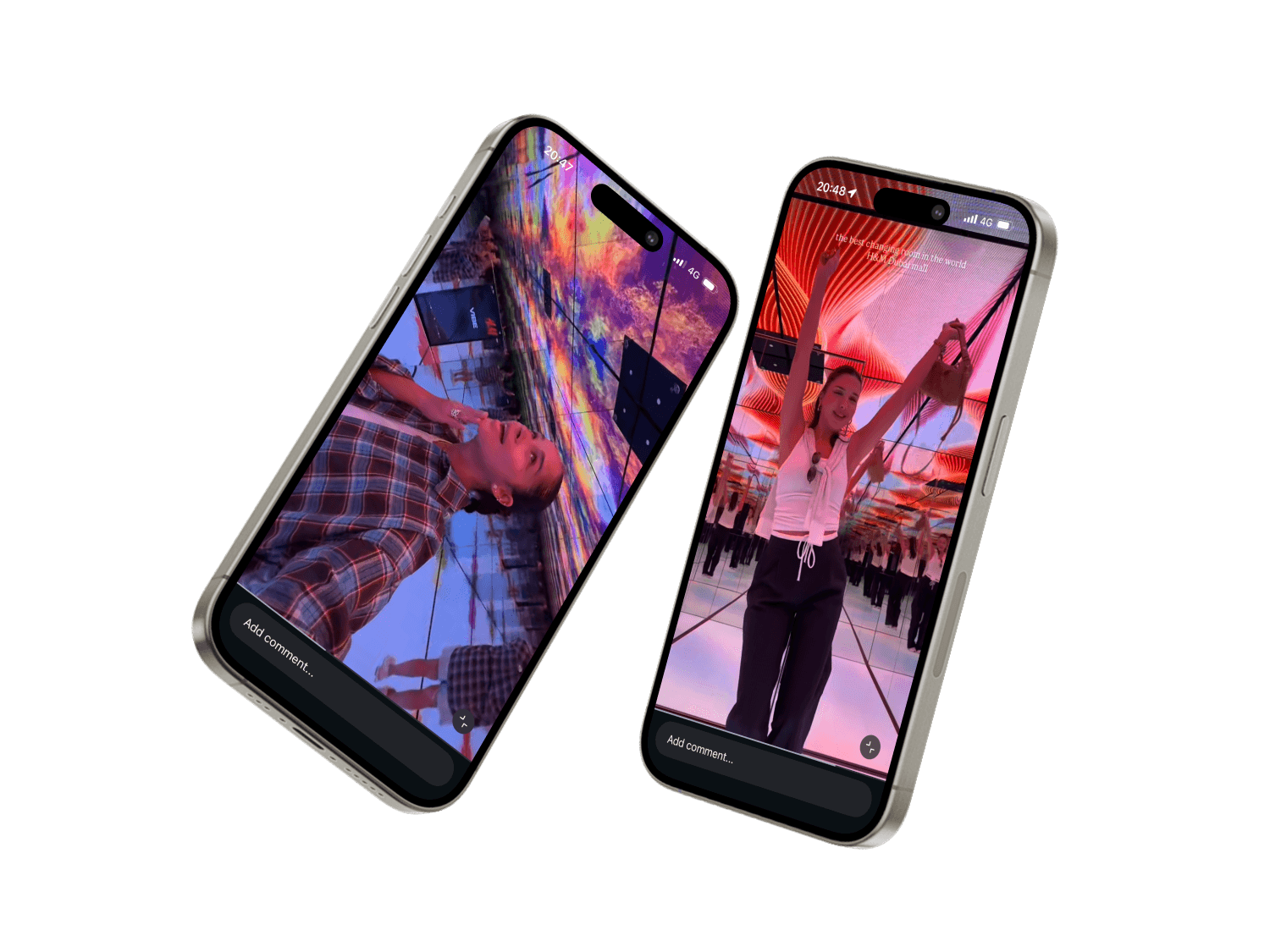
We set out to turn the try-on moment into something entirely new: an immersive space where fashion meets fun — and trying on clothes becomes an experience worth sharing.

Challenge
From a business perspective, this was part of H&M’s 2024 brand relaunch, aiming to reclaim its position as a global leader in fashion. The store experience needed to reflect this ambition. To attract a younger audience (especially the fashion-forward, TikTok-native crowd), we needed something that would drive organic social sharing and make our stores a destination again.
From a customer point of view, traditional fitting rooms are often perceived as uninspiring. They make it hard to envision an outfit in its real setting: what will a sequence skirt look like on a night out, a linnen dress on a vacation?
Approach
I was brought in to design the digital interface — a touchscreen that let customers control the music, lighting, and environment inside the fitting room. I created the designs in Figma and collaborated with developers to bring them to life.
Content creators delivered locally adapted themes: Berlin’s had a Tempelhof airfield vibe, while Korea’s featured the tropical energy of Jeju Island. Meanwhile, the store rebuild PM handled on-site installation, making sure the physical hardware matched the intended experience.
The approach wasn’t according to your traditional design process — there was no formal discovery or iteration phase. The concept was already in motion when I joined, so I focused on shaping a digital layer that made the physical experience feel seamless and on-brand.
Solution
Inside the Immersive Fitting Room, customers could choose their own music, adjust the lighting, and set a themed scene that matched their outfit or mood. Trying on a look for a night out in Berlin? Tap into the club scene. Heading to Jeju? Cue the palm trees and sea breeze.
The experience was playful, intuitive, and totally in tune with how people express themselves today — especially on social media


Impact
The immersive fitting rooms created a buzz and sparked attention online, as intended. They became a talking point among customers and were often highlighted in social media content and store reviews. The concept helped bring energy to the fitting room experience and aligned with the brand’s ambition to create more engaging in-store moments.
The project also opened up new unorthodox ways of thinking about the store experience — not just as a space restricted to shopping, but as an opportunity to create memorable, shareable brand experiences.
Reflection
While the end result was exciting and well-received, the project skipped over critical early stages. I wasn’t involved in defining the problem or validating the concept, and success metrics weren’t clearly set. In hindsight, I would’ve preferred a proper discovery phase (including user testing or a proof of concept) before investing in such a large-scale, hardware-heavy installation.
Still, the project was a valuable reminder of how physical and digital design can merge to create experiences that are not only functional, but emotional and shareable.